
Showing posts with label Savings. Show all posts
Showing posts with label Savings. Show all posts
Friday, January 8, 2010
How to fix your finances in 2010 (WSJ)

Wednesday, January 6, 2010
Your Ultimate Shelf Life Guide - Save Money, Eat Better, Help The Environment

Not sure how long that Costco sized salsa bottle will last? Can it be frozen for later use? I was referred to this site by a reader and wanted to share it with my readers. Check out StillTasty.com and learn how long foods last and what you can do to maximize its shelf life.
Tuesday, December 29, 2009
Living large in lean times

Mens Health Magazine brought together a roster of contributors and peered into the pocketbooks of more than 1,000 men in their largest-ever financial survey to help readers find ways to live better, for less. Read on, and start reaping the rewards.
Happy New Years!
Happy New Years!
Sunday, December 6, 2009
Five ways wireless carriers try to gouge you

Tuesday, November 10, 2009
Life on severance ...is time running out?

If the article below resembles your circumstance, you need my help...
Twitter: http://twitter.com/BudgetGrinch
Columns on Examiner: Link
LivePerson Consultations: Link
Email Contact: nanavati@givinggirnch.com
Paul Joegriner hasn't worked since March 2008, when he was laid off from his job as chief executive officer of a small bank. But you wouldn't know it by appearances. His wife, Marzena, shuttles their two young children to private school every morning. The family recently vacationed in Virginia Beach, Va., and likes to dine on Porterhouse steaks.
The family's lifestyle over the past year and a half has been propped up by a $200,000 severance package and another $100,000 in savings -- funds the family has burned through rapidly. By Mr. Joegriner's own calculations, the family will be out of money in six months if he doesn't find work.
Friday, September 18, 2009
Where the (every day) chear air fares are
Air Fares: A Short-Term Forecast
According to the Bureau of Transportation and Statis tics (BTS) domestic U.S. air fares had the largest percent decline since 2002. With summer in our rear view mirror, the prospects of a slow economic recovery and a decrease in airline capacity many experts believe prices have stabilized. There are still great deals out there; you just have to know where to look. The following suggestions may improve your odds.
Destination Selection
* Trips to business markets, especially those dominated by one carrier (a fortress hub) generally cost more. A fortress hub is a large airport dominated by one carrier. Americ an at Dallas-Ft. Worth, Continental at Houston Intercontinental and Delta at Cincinnati are examples. In these markets the dominant carrier provides non-stop service to points throughout the nation. This level of service allows the carrier to maintain pricing power.
* Pick a destination that is served my multiple carriers (ideally both major and low cost carriers).
* Carriers like Air Tran, Southwest, Frontier, JetBlue, Virgin America, Spirit and Allegiant have taken market share from major carriers by introducing lower fares. This doesn’t mean they always offer the lowest fare. To maintain market share, major carriers will price match. Austin, Las Vegas and Ft. Lauderdale are three examples of markets with a healthy mix of major and LCC competition.
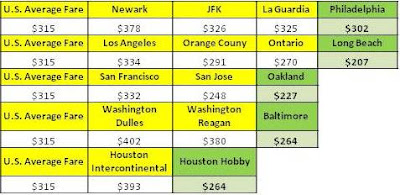
* Select a destination with multiple airports. Below are the average itinerary fares for Houston, New York City, Los Angeles, San Francisco and the Washington D.C. area. As you can see, the fares vary greatly by airport. If you are flexible research fares to an alternative airport. Tip: add ground transportation costs (taxi, car rental, public transportation) to your airfare to compare the total cost of each option.
The Lowest Average Fares in America
Of the top 100 airports (by originating passengers) the most affordable destinations are Long Beach, Oakland, Burbank, Dallas (Love Field) and Las Vegas. Conversely, the most expensive airports are Huntsville, Cincinnati, Grand Rapids, Savannah and Des Moines. Below are the top 30 from both ends of the spectrum. It should not shock you that many of the expensive markets have fortress hubs or limited competition.

A Final Tip: The Best Time to Travel in 2009
The period between Thanksgiving and Christmas is a low period for air travel. During this time both business and leisure travel drop significantly. In an attempt to generate bookings airlines open their inventory to their lowest fares. But don’t buy your ticket too soon...we’re still in a recession after all! There is likelihood even lower/sale fares will emerge between 60 and 21 days to departure – especially in competitive markets. Of course, the only thing less rational than air fares are trying to predict them...buyer beware and happy trails!
According to the Bureau of Transportation and Statis
 tics (BTS) domestic U.S. air fares had the largest percent decline since 2002. With summer in our rear view mirror, the prospects of a slow economic recovery and a decrease in airline capacity many experts believe prices have stabilized. There are still great deals out there; you just have to know where to look. The following suggestions may improve your odds.
Destination Selection
* Trips to business markets, especially those dominated by one carrier (a fortress hub) generally cost more. A fortress hub is a large airport dominated by one carrier. Americ
 an at Dallas-Ft. Worth, Continental at Houston Intercontinental and Delta at Cincinnati are examples. In these markets the dominant carrier provides non-stop service to points throughout the nation. This level of service allows the carrier to maintain pricing power.
* Pick a destination that is served my multiple carriers (ideally both major and low cost carriers).
* Carriers like Air Tran, Southwest, Frontier, JetBlue, Virgin America, Spirit and Allegiant have taken market share from major carriers by introducing lower fares. This doesn’t mean they always offer the lowest fare. To maintain market share, major carriers will price match. Austin, Las Vegas and Ft. Lauderdale are three examples of markets with a healthy mix of major and LCC competition.
* Select a destination with multiple airports. Below are the average itinerary fares for Houston, New York City, Los Angeles, San Francisco and the Washington D.C. area. As you can see, the fares vary greatly by airport. If you are flexible research fares to an alternative airport. Tip: add ground transportation costs (taxi, car rental, public transportation) to your airfare to compare the total cost of each option.

Source: Bureau of Transportation and Statistics
The Lowest Average Fares in America
Of the top 100 airports (by originating passengers) the most affordable destinations are Long Beach, Oakland, Burbank, Dallas (Love Field) and Las Vegas. Conversely, the most expensive airports are Huntsville, Cincinnati, Grand Rapids, Savannah and Des Moines. Below are the top 30 from both ends of the spectrum. It should not shock you that many of the expensive markets have fortress hubs or limited competition.

Source: Bureau of Transportation and Statistics
A Final Tip: The Best Time to Travel in 2009
The period between Thanksgiving and Christmas is a low period for air travel. During this time both business and leisure travel drop significantly. In an attempt to generate bookings airlines open their inventory to their lowest fares. But don’t buy your ticket too soon...we’re still in a recession after all! There is likelihood even lower/sale fares will emerge between 60 and 21 days to departure – especially in competitive markets. Of course, the only thing less rational than air fares are trying to predict them...buyer beware and happy trails!
Tuesday, September 8, 2009
Haggle Your Way To Savings Redux
 In July I wrote this column "Haggle Your Way To Savings." This month Kiplinger's published an article on Bartering by Laura Cohn presenting another tactic to get the things you need and want. Ms. Cohn notes that barter requests have jumped nearly 80% on sites like Craig's List. In addition, she offers tips you can use before venturing into the barter foray. You can read a full article here: http://www.kiplinger.com/magazine/archives/2009/08/lowdown-bartering.html
Monday, August 10, 2009
Is Spending Patriotic?
 By Shreyas Nanavati
Individual savings rates in America have risen to 6%. Studies indicate the savings rate will reach 8%. All it took was a crash in the home and stock markets, high unemployment and fear of a slow, painful recovery to turn our debt-happy society into a nation of savers.
Not only are individuals and families cutting back, companies continue to trim expenses in hopes of strengthening their balance sheet. As long as the consumer and corporate sectors feed off each others' uncertainly we're in a a vicious cycle.
Advertisers have been trying to link spending with patriotism. It's true, for the economy to prosper, consumers and corporations need to pull out their wallets, but is it patriotic to spend?
Incentives Favor Saving
Key market forces are fueling our growth in savings. Credit is harder to come by. Home equity loans, once a cheap source of cash, are no longer a given option. In addition to deteriorating home prices, investment and retirement portfolios are no longer a source of security or riches. On top of that job loss, record government debt, a slow to materialize stimulus package and uncertainty about the future of social security have all nudged our spend-first culture to save more, manage debt and make rational spending decisions.
Balance In Due Time
As savings accumulate, economic uncertainty dissipates and the stock/home markets stabilize these patterns will tip in favor of spending. Until then, it’s not our obligation to support the economy by consuming things we do not need or can not afford (cars for clunkers enthusiasts, heed my warning). Do what is in your best interest, eventually balance will be restored and the nation will be stronger for it.
Wednesday, July 8, 2009
Haggle Your Way to Savings
 Haggling does not come naturally. Fortunately, I’ve had the pleasure of travelling to places where the first price is rarely the final price. Having seen this process at its finest, I’ve compiled a list of best practices to help you haggle your way to a better deal.
 What is Negotiable
Haggling extends beyond garage sales, open air markets and your next car. You can haggle to improve your situation on a variety of items: phone, cable, gym membership and home improvement jobs come to mind. While there are many things we can haggle on, it’s important to temper expectations if a product or service is non-negotiable. This could be the case at national retail outlets, dining establishments, etc. A strategy in these situations is to ask if the seller offers specials or is planning to have a sale soon.
Start by Asking for a Better Deal
Competition, especially in highly competitive industries dominated by independent business owners, is fierce. Start the process by asking for a better price. Smart Money Magazine even suggests that medical costs are negotiable: http://www.smartmoney.com/spending/deals/how-to-cut-your-health-care-costs-14650/.
Do Your Diligence
It’s common for businesses to beat a competitor’s price. This is especially true in situations where many sellers offer the same or similar product. Craft markets or touristy places are classic examples. Walk around and get a feel for the going rate of an item before you haggle with a vendor.
***********
For tips on a wide-range of money matters, visit this GivingGrinch.com recommended site: www.moneyreallymatters.com
***********
Be Even Keeled & Not Afraid to Smile
Have fun with the haggling experience. The best hagglers I’ve seen have a price in mind and a strategy to achieve their objectives, but they also maintain a pleasant disposition. This allows them to be persistent without being unpleasant.
Grease the Wheel
• Offer to pay in cash
• Offer to purchase on the spot
• Offer to recommend shop/service to your friends and colleagues
Work the Variables
Often there are several variables inclusive or exclusive of the final price. If you are unable to reduce one area try to improve your situation in another. Earlier this year while on a trip we walked into a hotel without a reservation. After chatting with the front desk manager and determining that the hotel was only 70% occupied, we asked for a lower rate than was quoted. The manger was not willing to reduce the rate, but we were able to secure a larger room and a welcome basket with snacks and beverages at no extra cost.
***********
Business owners, hiring a virtual assistant can save time and money: www.integrityofficesolutions.com
***********
Be Willing to Walk Away
If you don’t get the price you require and are able to make due leave your information with the seller, ask them to contact you if they are willing to meet your terms.
Don’t Walk Away After You Agree on a Price
It is bad etiquette and a waste of time to negotiate in bad faith.
Reader Tips
Bartering or swapping goods is a bit like haggling and another way to save money. There are a bunch of websites that offer these services. Here are a few:
• HomeExchange.com
• Craigslist.com (barter section)
• MakeupAlley.com
• PaperBackSwap.com
• SwapThing.com
• TargetBarter.com
• TextSwap.com
• BarterBee.com
Submitted by Shefali in NYC
Share Your Haggling Tips:
Share your haggling tips and success stories with our readers. You can post a comment on our blog or send me an email: advice@givinggrinch.com.
Wednesday, May 6, 2009
Your Tax Refund
 BudgetFree Approach
by S. Nanavati
This year the Internal Revenue Service reports an average tax refund over $2,700. Use the principles of the BudgetFree for Life System to prioritize how to use your refund.
Survival Needs:
Food, Warmth, Water, Shelter…
Utilities: If you’re having trouble fulfilling critical survival needs (electric, water and heating, for example) your refund should be used to address these matters.
Mortgage: For those without debt and job insecurity consider lowering monthly housing payments. Refinancing isn’t for everyone – you need home equity, a high credit score to qualify for the lowest rates and $2,000 - 3,000 for closing costs. To figure out whether refinancing is right for you, try this online calculator: http://www.bankrate.com/.
Safety Needs
Are you protected against uncertainty or disaster (insurance, home security, etc)? Do you have an emergency fund? Is your job secure? Do you have the skills necessary to compete in the market place? Are meeting your long-term retirement objectives?
Emergency Fund: If your survival needs are met, building a cash fund should be a priority. My September 2008 Newsletter “Your Emergency Fund,” discusses the importance of maintaining a 6-month emergency cash fund.
Tip: Beyond security, a cash fund allows you to save money. Insurance deductibles are one example. According to the Insurance Information Institute raising your deductible from $200 to $500 can cut 15-30% off your premium. Increasing your deductible to $1000 can bring up to 40% in savings. If disaster strike, your emergency fund will cushion the blow of a higher deductable.
Credit Card Debt: Putting money in the bank when you are paying a higher interest on debt doesn't make financial sense. If your job situation is secure and you're carrying credit card debt use your refund to pay down high interest obligations. Start by addressing the cards with the highest interest.
Long Term/Retirement Investing: The correction in the stock market has created an investment opportunity for those with a long-term horizon. If your credit card debt is paid off, you have an emergency fund and don’t have a need for your refund money for the next 3-5 years put it towards your long-term/retirement goals.
Retirement versus College Fund: There are many ways to fund a college education (loans, scholarships, ROTC, work study, etc), but saving is the only way to fund your retirement. Make certain your retirement plan is on track before addressing a college fund.
Social Needs:
If you're on top of your debt, secure in your job and up-to-date with short/long-term financial planning focus some of your refund on personal aspirations – vacation, membership, whatever lifts your sense of belonging and acceptance.
Esteem Needs:
Invest in Yourself:
• Hire a career coach or personal trainer
• Attend classes that enhance knowledge and skills
• Attend a conference to network, increase knowledge and possibly find your next job
Tip: Adjust your withholding so next year’s refund isn’t so large. The IRS provides a withholding calculator so you can fine-tune your taxes to get more in every paycheck. Make sure to automatically transfer this extra money to a savings account so it’s put towards your goals, not your whims.
Thursday, April 16, 2009
Guest Blogger: Money Smart
This month’s guest writer is Vijai Anand. Vijai writes articles on becoming “money smart” for his website www.moneyreallymatters.com. Last year, when I started www.GivingGrinch.com, Viaji was the first person to interview me (link). This year he agreed to share his financial philosophy with my readers.
Money Smart by Vijai Anand (www.moneyreallymatters.com)
In recent months financial security has become a priority. Are you in control of your finances? Are you Money Smart?
What is Money Smart? Is it clipping coupons, being the first in line for a big sale, signing up for freebies or raffles or comparison shopping online? I don't see anything wrong with saving money, if fact a dollar saved is two earned. Need proof? Check out this article: (Link). Nonetheless, these activities do not make a person Money Smart.
Money Smart is about Making Extra, Spending Wisely, Saving Graciously and Managing Right.
Make Extra
I encourage everyone to profit beyond your job. There are many ways to make extra money. You can turn your passions or hobbies into an income stream. Visit a local farmers market for ideas. You’ll see people selling homemade soap, spice rubs, jewelry, craft work, etc. Another example is to write an eBook. Maybe you’re a musician. Put together a book of lessons and sell it online for a nominal amount (say $10). Even if only 10 people buy your book every month, it adds up to $1200/year in passive income! Bottom Line: Tap into your abilities and you will find a niche to making extra cash.
Spend Wise
As our needs grow so do our costs. We need a roof over our head, food, clothing, gas and so forth. Therefore, it’s important to prioritize how we spend our money. Always keep in mind the difference between a need and a want.
An example, if you don’t own a television, buying a new one for a reasonable price is spend-wise. If you already a have nice TV and buy a big screen set in time for Super Bowl, that’s a different story. This is not a need, but a want. Everyone has different income considerations, but the need versus want principle can be applied to purchases (and incomes) big or small.
Save Graciously
Savings are like antibodies. If you have enough you become resistant to bad diseases. Without ample savings you will struggle when there is an unplanned need for money. Remember, patience is virtue so put money away on periodic basis. If you have children, take a queue from them. You don't have to open a bank account. Use a piggy bank and every day toss in your spare change. Some people have a five dollar rule, every time they receive a five dollar bill, they put it to savings. You’ll be surprised how quick it can grow to hundreds of dollars. If you’re a “spend first, save later” type set up an automatic savings plan with your bank to ensure you only spend what remains.
Manage Right
It’s your money - you earned it - you should have some control of it. Don’t let others make decisions for you. You can take the advice and guidance, but you need to know enough to be able to manage your money the way you see fit.
For example, if you plan to buy a home or save for a child’s education you can talk to an expert, do research on the internet or discuss with peers. The point is to collect information so that you can make an educated decision on how to channel your money to meet your goals.
Money Smart
By now you’ve probably realized that becoming Money Smart is not a bunch of tricks and tips. Money Smart is about changing your thought process and taking actions to make a positive, long-term difference in your life. You can start out slowly, but be consistent.
1. Think about ways you can make extra, spend wise, save graciously and manage right.
2. Learn good money management tips and techniques from various resources (Internet, community groups, expert advice, etc).
3. Read books and magazines that focus on money management, savings ideas, etc. I recommend a few books on my site, www.moneyreallymatters.com.
4. Attend free seminars or workshops arranged by libraries, banks and financial institutions, but filter out the marketing (sales) pitch and scare tactics; take only the information you need. Remember, if a pitch sounds too good to be true, it probably is.
5. Steadily change your habits and implement the ideas and strategies you’re learning.
6. Teach your kids about money to cultivate a culture of saving.
As Lau Tuz said, “A journey of thousand miles always starts with a single step.” When you put it all together, being Money Smart is about personal financial literacy – the first step to financial security.
About the Author
Vijai Anand is a senior web developer by profession and the owner of a web design shop www.igurus.net. By passion he is a husband, father, self made investor, money mentor (pursuing his CFP) and entrepreneur. He writes freelance and for his website www.moneyreallymatters.com.
Money Smart by Vijai Anand (www.moneyreallymatters.com)
In recent months financial security has become a priority. Are you in control of your finances? Are you Money Smart?
What is Money Smart? Is it clipping coupons, being the first in line for a big sale, signing up for freebies or raffles or comparison shopping online? I don't see anything wrong with saving money, if fact a dollar saved is two earned. Need proof? Check out this article: (Link). Nonetheless, these activities do not make a person Money Smart.
Money Smart is about Making Extra, Spending Wisely, Saving Graciously and Managing Right.
Make Extra
I encourage everyone to profit beyond your job. There are many ways to make extra money. You can turn your passions or hobbies into an income stream. Visit a local farmers market for ideas. You’ll see people selling homemade soap, spice rubs, jewelry, craft work, etc. Another example is to write an eBook. Maybe you’re a musician. Put together a book of lessons and sell it online for a nominal amount (say $10). Even if only 10 people buy your book every month, it adds up to $1200/year in passive income! Bottom Line: Tap into your abilities and you will find a niche to making extra cash.
Spend Wise
As our needs grow so do our costs. We need a roof over our head, food, clothing, gas and so forth. Therefore, it’s important to prioritize how we spend our money. Always keep in mind the difference between a need and a want.
An example, if you don’t own a television, buying a new one for a reasonable price is spend-wise. If you already a have nice TV and buy a big screen set in time for Super Bowl, that’s a different story. This is not a need, but a want. Everyone has different income considerations, but the need versus want principle can be applied to purchases (and incomes) big or small.
Save Graciously
Savings are like antibodies. If you have enough you become resistant to bad diseases. Without ample savings you will struggle when there is an unplanned need for money. Remember, patience is virtue so put money away on periodic basis. If you have children, take a queue from them. You don't have to open a bank account. Use a piggy bank and every day toss in your spare change. Some people have a five dollar rule, every time they receive a five dollar bill, they put it to savings. You’ll be surprised how quick it can grow to hundreds of dollars. If you’re a “spend first, save later” type set up an automatic savings plan with your bank to ensure you only spend what remains.
Manage Right
It’s your money - you earned it - you should have some control of it. Don’t let others make decisions for you. You can take the advice and guidance, but you need to know enough to be able to manage your money the way you see fit.
For example, if you plan to buy a home or save for a child’s education you can talk to an expert, do research on the internet or discuss with peers. The point is to collect information so that you can make an educated decision on how to channel your money to meet your goals.
Money Smart
By now you’ve probably realized that becoming Money Smart is not a bunch of tricks and tips. Money Smart is about changing your thought process and taking actions to make a positive, long-term difference in your life. You can start out slowly, but be consistent.
1. Think about ways you can make extra, spend wise, save graciously and manage right.
2. Learn good money management tips and techniques from various resources (Internet, community groups, expert advice, etc).
3. Read books and magazines that focus on money management, savings ideas, etc. I recommend a few books on my site, www.moneyreallymatters.com.
4. Attend free seminars or workshops arranged by libraries, banks and financial institutions, but filter out the marketing (sales) pitch and scare tactics; take only the information you need. Remember, if a pitch sounds too good to be true, it probably is.
5. Steadily change your habits and implement the ideas and strategies you’re learning.
6. Teach your kids about money to cultivate a culture of saving.
As Lau Tuz said, “A journey of thousand miles always starts with a single step.” When you put it all together, being Money Smart is about personal financial literacy – the first step to financial security.
About the Author
Vijai Anand is a senior web developer by profession and the owner of a web design shop www.igurus.net. By passion he is a husband, father, self made investor, money mentor (pursuing his CFP) and entrepreneur. He writes freelance and for his website www.moneyreallymatters.com.
Wednesday, April 8, 2009
BudgetFree Investing
***********
GivingGrinch.com
BudgetFree for Life!
Editor: Shreyas Nanavati
***********
Blog: http://www.givinggrinch.blogspot.com/
Website: http://www.givinggrinch.com/
***********
BudgetFree Investing
Having short-term financial security and a long-term savings are crucial SAFETY needs. Whether you invest individually or work with a professional it is important to understand how your money is invested and the risks involved.
Know Your Goals
Planning for retirement is an on-going process. You must know how much income you’ll need to live comfortably, provide adequate health care and ensure financial security for dependents. Online sites like http://www.schwab.com/ and http://www.bankrate.com/ provide tools to help you with this process.
Know What It Takes
North Americans are notorious for living beyond their means. Saving rates are very low and in decline.
 Because of this, an above average return on our investments is a requisite to meet retirement goals. To get higher returns, one must take higher risks. A simple example:
Assumptions
Work Life: 40 years
Historical Inflation: 3%
Historical 5-Year CD Rates (lower risk): 5%
Historical Stock Market Returns (higher risk): 8%
Calculator: http://www.bankrate.com/calculators/savings/saving-million-dollars.aspx
Saving $275/month for 40 years (8% market return) will result in a million dollars. Saving $675/month for 40 years (5% CD return) will also result in a million dollars. The difference goes beyond risk and $400/month. Historical information does not account for market timing or inflation fluctuation. In the past 20 years the average stock market return, adjusted for inflation, has been 8%. Over the past 10 years, that number falls to 1%. Since January 1, 2000 the number falls to -4%. Meanwhile inflation rates in the past 20 years have fluctuated between 1% and 6.3%. Higher inflation impacts real income invested in less risky vehicles (CDs, Money Market, Treasuries, etc). Source: http://www.moneychimp.com/features/market_cagr.htm
Bottom Line: Market volatility has hampered the retirement plans of millions – especially the average investor who takes greater risk to make up for lack of savings. I’m not advising you how to invest, but I am pointing out the importance of saving so you are not completely dependent on the market to make up the difference.
Know Your Investments
Underfunding your retirement is unsettling. Not understanding what is in your portfolio is downright scary – especially when the market takes a turn for the worse. Before making an investment decision make sure you understand the investment, its upside and downside. Three suggestions:
1. Beware of False Promises: There is no such thing as a no risk investment or a get rich fast scheme (the only person getting rich is the one selling the scheme). Do not agree to anything on the spot or act on testimonials from strangers.
2. Don't Gamble With Money You Can't Afford To Lose: The less you can afford to lose, the more conservative you should be in your choice of investments. A young person with a long-term horizon can absorb more risk because they have the benefit of time. If you’re close to retirement a volatile portfolio can wreak havoc on your golden years. Tip: If you are meeting your investment goals and want to invest for fun set up a separate account that is isolated from your essential savings.
3. Diversify: Don’t put all your money in one stock, bond, fund family, sector, commodity, industry or region of the world.
Self-Help
Even if you choose to work with an investment advisor it is important to understand a wide-range of investment topics. My recommendation is to subscribe (or read at the library) one or more of the following every month: Kiplinger’s, Money Magazine or Smart Money. These magazines cater to a general audience. If you are new to investing, don’t get frustrated if topics seem foreign. Over time you will gain familiarity.
Know Your Advisor’s Place
If you choose to work with an investment professional, remember you are buying their service and they must work for you and your interests. Interview several before settling on one. Although I personally do not work with an investment professional, I would recommend a fee-based advisor rather than one who makes money on commission (annuities, mutual funds and frequent trading generate a lot of commission for a broker).
Secure Your Short Term
Make sure your current financial needs are addressed. For advice on an Emergency Fund, see my September 2008 Newsletter: http://givinggrinch.blogspot.com/2008_09_01_archive.html
BudgetFree for Life Consulting
Tailored for individuals, couples or families, this package comes with all the training, tools, techniques and support you’ll need to live BudgetFree for Life. It’s an affordable way to bring fiscal and personal balance to your life. To learn more, check out my 60 second presentation:
Reader Tips
Survival: Explore the Bulk Section and Eat Healthy for Less
The food industry makes it easy for us to eat processed foods, but they good for us or the environment. With food prices rising and incomes shrinking it’s time to make grains and beans the centerpiece of our diets.
Begin your day with whole grain cereals topped with nuts and dried fruit. For lunch combine whole grains with beans, veggies and a sauce or dressing. For dinner casseroles, pilafs and stir fries. Need a quick snack? Try Bulgar, couscous, instant black beans or re-fried beans with veggies. Submitted by Susan B. in Hancock, Michigan
Social: Road Trip Clip
I clip coupons from restaurant chains and keep them in the car to use on road trips.
GivingGrinch.com
BudgetFree for Life!
Editor: Shreyas Nanavati
***********
Blog: http://www.givinggrinch.blogspot.com/
Website: http://www.givinggrinch.com/
***********
BudgetFree Investing
Having short-term financial security and a long-term savings are crucial SAFETY needs. Whether you invest individually or work with a professional it is important to understand how your money is invested and the risks involved.
Know Your Goals
Planning for retirement is an on-going process. You must know how much income you’ll need to live comfortably, provide adequate health care and ensure financial security for dependents. Online sites like http://www.schwab.com/ and http://www.bankrate.com/ provide tools to help you with this process.
Know What It Takes
North Americans are notorious for living beyond their means. Saving rates are very low and in decline.
 Because of this, an above average return on our investments is a requisite to meet retirement goals. To get higher returns, one must take higher risks. A simple example:
Assumptions
Work Life: 40 years
Historical Inflation: 3%
Historical 5-Year CD Rates (lower risk): 5%
Historical Stock Market Returns (higher risk): 8%
Calculator: http://www.bankrate.com/calculators/savings/saving-million-dollars.aspx
Saving $275/month for 40 years (8% market return) will result in a million dollars. Saving $675/month for 40 years (5% CD return) will also result in a million dollars. The difference goes beyond risk and $400/month. Historical information does not account for market timing or inflation fluctuation. In the past 20 years the average stock market return, adjusted for inflation, has been 8%. Over the past 10 years, that number falls to 1%. Since January 1, 2000 the number falls to -4%. Meanwhile inflation rates in the past 20 years have fluctuated between 1% and 6.3%. Higher inflation impacts real income invested in less risky vehicles (CDs, Money Market, Treasuries, etc). Source: http://www.moneychimp.com/features/market_cagr.htm
Bottom Line: Market volatility has hampered the retirement plans of millions – especially the average investor who takes greater risk to make up for lack of savings. I’m not advising you how to invest, but I am pointing out the importance of saving so you are not completely dependent on the market to make up the difference.
Know Your Investments
Underfunding your retirement is unsettling. Not understanding what is in your portfolio is downright scary – especially when the market takes a turn for the worse. Before making an investment decision make sure you understand the investment, its upside and downside. Three suggestions:
1. Beware of False Promises: There is no such thing as a no risk investment or a get rich fast scheme (the only person getting rich is the one selling the scheme). Do not agree to anything on the spot or act on testimonials from strangers.
2. Don't Gamble With Money You Can't Afford To Lose: The less you can afford to lose, the more conservative you should be in your choice of investments. A young person with a long-term horizon can absorb more risk because they have the benefit of time. If you’re close to retirement a volatile portfolio can wreak havoc on your golden years. Tip: If you are meeting your investment goals and want to invest for fun set up a separate account that is isolated from your essential savings.
3. Diversify: Don’t put all your money in one stock, bond, fund family, sector, commodity, industry or region of the world.
Self-Help
Even if you choose to work with an investment advisor it is important to understand a wide-range of investment topics. My recommendation is to subscribe (or read at the library) one or more of the following every month: Kiplinger’s, Money Magazine or Smart Money. These magazines cater to a general audience. If you are new to investing, don’t get frustrated if topics seem foreign. Over time you will gain familiarity.
Know Your Advisor’s Place
If you choose to work with an investment professional, remember you are buying their service and they must work for you and your interests. Interview several before settling on one. Although I personally do not work with an investment professional, I would recommend a fee-based advisor rather than one who makes money on commission (annuities, mutual funds and frequent trading generate a lot of commission for a broker).
Secure Your Short Term
Make sure your current financial needs are addressed. For advice on an Emergency Fund, see my September 2008 Newsletter: http://givinggrinch.blogspot.com/2008_09_01_archive.html
BudgetFree for Life Consulting
Tailored for individuals, couples or families, this package comes with all the training, tools, techniques and support you’ll need to live BudgetFree for Life. It’s an affordable way to bring fiscal and personal balance to your life. To learn more, check out my 60 second presentation:
Reader Tips
Survival: Explore the Bulk Section and Eat Healthy for Less
The food industry makes it easy for us to eat processed foods, but they good for us or the environment. With food prices rising and incomes shrinking it’s time to make grains and beans the centerpiece of our diets.
Begin your day with whole grain cereals topped with nuts and dried fruit. For lunch combine whole grains with beans, veggies and a sauce or dressing. For dinner casseroles, pilafs and stir fries. Need a quick snack? Try Bulgar, couscous, instant black beans or re-fried beans with veggies. Submitted by Susan B. in Hancock, Michigan
Social: Road Trip Clip
I clip coupons from restaurant chains and keep them in the car to use on road trips.
Monday, September 1, 2008
Your Emergency Fund
***********
http://www.givinggrinch.com/
BudgeFree for Life!
Volume 1, Issue 5
Editor: Shreyas Nanavati
***********
Visit the GivingGrinch Website: http://www.givinggrinch.com/
***********
September 2008: Your Emergency Fund
Six months cash is an essential safety need. Not only does it bring short-term security in times of uncertainty, it’s also a hedge that allows you to lower costs associated with other safety needs.
***********
GivingGrinch.com interview: I had the pleasure of being interviewed by moneyreallymatters.com. Read the interview and visit the blog: http://www.moneyreallymatters.com//
***********
Experts tout the need to have a fund to cover living expenses in case of emergency, but how much is enough? In this newsletter we’re going to answer three points:
1. Why six months cash is ideal
2. How to determine the amount you need
3. Some tactics you can use to trim three costly safety needs without negatively impacting your lifestyle
Why Six Months
This logic is based on the average duration of unemployment. Presently the average length of unemployment is 18 weeks – just over four months. This period can vary based on factors including where you live, your qualifications and willingness to relocate. Having six months cash gives you the flexibility and security necessary to make sound decisions during times of distress without having to tap other sources of credit, savings or assets.
How to Calculate your Six Months
Having enough in your emergency fund to ensuring you continue to live a balanced life is crucial. The checklist below will allow you to calculate your major physiological, safety and social expenditures. If you need a refresher on how the hierarchy works, click here: http://www.givinggrinch.com/.
Physiological Expenses:
• Mortgage/Rent
• Food
• Utilities: Electricity, Gas, Water
• Prescription Medicine
Safety:
• Health Insurance: Medical (COBRA?), Dental (optional), Eye (optional)
• Other Insurance: Auto, Home, Life
• Utilities: Phone, Cell Phone, TV, Internet, Home Alarm, etc.
• Transportation: Gas, Public
• Taxes: Property, School, etc.
• Education/Daycare/Childcare
• Debt Obligations: Auto, Credit
Social:
• Personal/Entertainment Fund
• Personal Care/Grooming
***********
Need suggestions for how you can fulfill these and other categories for less? You can download our Master List of Budget Advice from either our website (http://www.givinggrinch.com/) or Blog (http://givinggrinch.blogspot.com/).
***********
Buoy your emergency fund with this simple tactic
Finding the money to build an emergency fund is not easy. The tactic I’m going to discuss will help immensely. Once you have a couple months cash stashed away, you have enough to cover most short-term uncertainties such as family emergencies, auto accidents or other unanticipated events. This will provide enough security to pursue a strategy that will save a lot of money in another safety area – insurance.
Many people choose the minimum deductibles for their home, auto or health insurance. That doesn’t mean you should. An emergency fund provides a cushion to manage minor mishaps. With this buffer you can avoid high premiums by focusing your coverage on major catastrophes.
Home Insurance
Health Insurance
While it’s important to be able to visit a doctor when necessary this is not the primary reason for having health insurance. The main purpose of health insurance is to make certain that you're covered against the high cost of hospital visits and specialty care. If you and the individuals on your plan are healthy, make infrequent doctor visits and rarely require prescription drugs consider the following:
Where should you put your emergency fund?
Keep this money safe and liquid, but not accessible for daily use. Saving accounts pay very little interest. Money markets offer a better return. You can also put a portion of your emergency fund in a CD where your principal is preserved even if you have to withdraw funds before maturity. Bankrate.com makes it easy to shop around for the best rate: http://www.bankrate.com/.
The Bottom Line
Having a emergency cash fund to cover life’s unexpected – and often untimely – events will not only bring you peace of mind; it will also open other avenues towards building a balanced life.
http://www.givinggrinch.com/
BudgeFree for Life!
Volume 1, Issue 5
Editor: Shreyas Nanavati
***********
Visit the GivingGrinch Website: http://www.givinggrinch.com/
***********
September 2008: Your Emergency Fund
Six months cash is an essential safety need. Not only does it bring short-term security in times of uncertainty, it’s also a hedge that allows you to lower costs associated with other safety needs.
***********
GivingGrinch.com interview: I had the pleasure of being interviewed by moneyreallymatters.com. Read the interview and visit the blog: http://www.moneyreallymatters.com//
***********
Experts tout the need to have a fund to cover living expenses in case of emergency, but how much is enough? In this newsletter we’re going to answer three points:
1. Why six months cash is ideal
2. How to determine the amount you need
3. Some tactics you can use to trim three costly safety needs without negatively impacting your lifestyle
Why Six Months
This logic is based on the average duration of unemployment. Presently the average length of unemployment is 18 weeks – just over four months. This period can vary based on factors including where you live, your qualifications and willingness to relocate. Having six months cash gives you the flexibility and security necessary to make sound decisions during times of distress without having to tap other sources of credit, savings or assets.
How to Calculate your Six Months
Having enough in your emergency fund to ensuring you continue to live a balanced life is crucial. The checklist below will allow you to calculate your major physiological, safety and social expenditures. If you need a refresher on how the hierarchy works, click here: http://www.givinggrinch.com/.
Physiological Expenses:
• Mortgage/Rent
• Food
• Utilities: Electricity, Gas, Water
• Prescription Medicine
Safety:
• Health Insurance: Medical (COBRA?), Dental (optional), Eye (optional)
• Other Insurance: Auto, Home, Life
• Utilities: Phone, Cell Phone, TV, Internet, Home Alarm, etc.
• Transportation: Gas, Public
• Taxes: Property, School, etc.
• Education/Daycare/Childcare
• Debt Obligations: Auto, Credit
Social:
• Personal/Entertainment Fund
• Personal Care/Grooming
***********
Need suggestions for how you can fulfill these and other categories for less? You can download our Master List of Budget Advice from either our website (http://www.givinggrinch.com/) or Blog (http://givinggrinch.blogspot.com/).
***********
Buoy your emergency fund with this simple tactic
Finding the money to build an emergency fund is not easy. The tactic I’m going to discuss will help immensely. Once you have a couple months cash stashed away, you have enough to cover most short-term uncertainties such as family emergencies, auto accidents or other unanticipated events. This will provide enough security to pursue a strategy that will save a lot of money in another safety area – insurance.
Many people choose the minimum deductibles for their home, auto or health insurance. That doesn’t mean you should. An emergency fund provides a cushion to manage minor mishaps. With this buffer you can avoid high premiums by focusing your coverage on major catastrophes.
Home Insurance
- According to the Insurance Information Institute (III), raising your deductible from $500 to $1000 can cut your premiums by 25%
- Combine your auto and homeowner’s policy under the same company can reduce your premiums an additional 5-10%
- Review your policy; make sure the information used to estimate the reconstruction of your home is accurate.
- Call your provider and ask for a list of all the discounts they offer. Some discounts you may not be aware of: home security, new home, auto/home, non smoker and claim free.
- Shop around
- According to the III, raising your deductible from $200 to $500 can cut 15-30% off your premium. Increasing your deductible to $1000 can bring up to a 40% savings
- Have an older car? Do the math on the premium you’re paying for collision (damage) and comprehensive (theft) coverage. Insurance companies will only pay the vehicle’s current resale value. To find out what your car is worth visit Kelly Blue Book at www.kbb.com. Compare the value with the amount you are paying annually for collision and comprehensive coverage. Consider cancelling this coverage if it's costing you more than the insurer will pay or if you have enough cash on hand to cover the difference if your car is totaled
- Call your provider and ask for a list of all the discounts they offer. Some discounts you may not be aware: low-mileage, longtime customer, defensive driver, anti-theft device, multiple car, passive restraints, ETF and home-auto discount
- Do you really need tow and rental car coverage?
- Shop around
Health Insurance
While it’s important to be able to visit a doctor when necessary this is not the primary reason for having health insurance. The main purpose of health insurance is to make certain that you're covered against the high cost of hospital visits and specialty care. If you and the individuals on your plan are healthy, make infrequent doctor visits and rarely require prescription drugs consider the following:
- Co-Pay: Raise this amount if doctor visits and prescription medication needs are few and far between
- Deductible: Same as with home and auto, raising your deductible reduces your premium
- Health savings accounts (HSAs) or similar programs allow participants to set pre-tax dollars for medical related expenses.
Where should you put your emergency fund?
Keep this money safe and liquid, but not accessible for daily use. Saving accounts pay very little interest. Money markets offer a better return. You can also put a portion of your emergency fund in a CD where your principal is preserved even if you have to withdraw funds before maturity. Bankrate.com makes it easy to shop around for the best rate: http://www.bankrate.com/.
The Bottom Line
Having a emergency cash fund to cover life’s unexpected – and often untimely – events will not only bring you peace of mind; it will also open other avenues towards building a balanced life.
Subscribe to:
Posts (Atom)


 Posts
Posts


